Introduction
In the Book of Ruth, significant theological formation occurs, presenting a beautifully written story placed distinctively between the chaos of the Book of Judges and the epic struggle between the prophet Samuel and the intractable King Saul in the first book of Samuel. Nestled in between this chaotic downward spiral and the recalcitrance of Saul, Ruth exhibits resilience amidst vulnerability, an outsider grafted into the Davidic lineage and its climactic conclusion in Christ.[1] A theology of hope for those found outside the normative structures of patriarchal, religious, and cultural normative spheres.
When placed in the proper contextual soil, Ruth illuminates a path from famine to fullness. A way replete with bold human initiative and a God sovereignly working in the background to fulfill the overarching story of the redemption of fallen humankind. In essence, this four-chapter literary masterpiece etches a map for the vulnerable to traverse in the particularity of their stories—a line of restoration and redemption leading to completion in the final fulfillment in Christ. This fulfillment illustrated by Ruth’s inclusion in Matthew’s Christological genealogy to open his Gospel. Matthew writes, “An account of the genealogy of Jesus the Messiah, the son of David, the son of Abraham… Salmon the father of Boaz by Rahab, and Boaz the father of Obed by Ruth, and Obed the father of Jesse, and Jesse the father of King David” (Matt. 1:1,5-6a, NRSV).[2]
Historical and Literary Context
To properly adjudicate the Book of Ruth, the modern reader should root themselves in the historical and literary contextualization of the writing. Most modern scholarship places the writing from either the monarchic to the post-exilic period of Israelite history. In his book, Introduction to the Old Testament as Scripture, Brevard Childs posits that the Wellhausen school of thought argues for a “post-exilic date on the evidence of the book’s location in the Hagiographa, its distance from the customs reported, its relation to Deuteronomic formulae (1.1), and alleged Aramaic influence on the language.”[3] In contrast, Childs expounds concerning the alternate view of Hals and Campbell arguing for monarchial dating based on von Rad’s ‘Solomonic Enlightenment theory.[4] Neither dating methodologies produce definitive results leaving the dating of Ruth ambiguous though likely after the Davidic monarchy.
In comparison, there is much scholarly consensus concerning the literary form of Ruth, the novella. As defined by Childs, the novella “consists of a highly artistic story which develops a plot through various scenes before reaching a climax.”[5] The scenes consisting of journeying from Bethlehem to Moab, experiencing disastrous losses in Moab, the definitive returning journey from Moab to Bethlehem, the assertive scheming of Naomi to connect Ruth with Boaz, the blossoming romance between Boaz and Ruth, and climaxing with the birth of Obed and the continuance of the Davidic/Messianic lineage through Ruth.
The Theology of the Book of Ruth
The theological concerns of this ancient “novella” derive primarily from the cultural exclusion and diminished ethnicity of the protagonist Ruth, the Moabitess, the hidden causality of God at work, and the fulfillment of the obligatory Levarite requirements of the kinsman-redeemer concerning property and existentially to the widowed Ruth with its implicative results. This modest book’s density of theological understanding provides the modern reader with a deepened understanding of the Divine at work in ordinary life events.
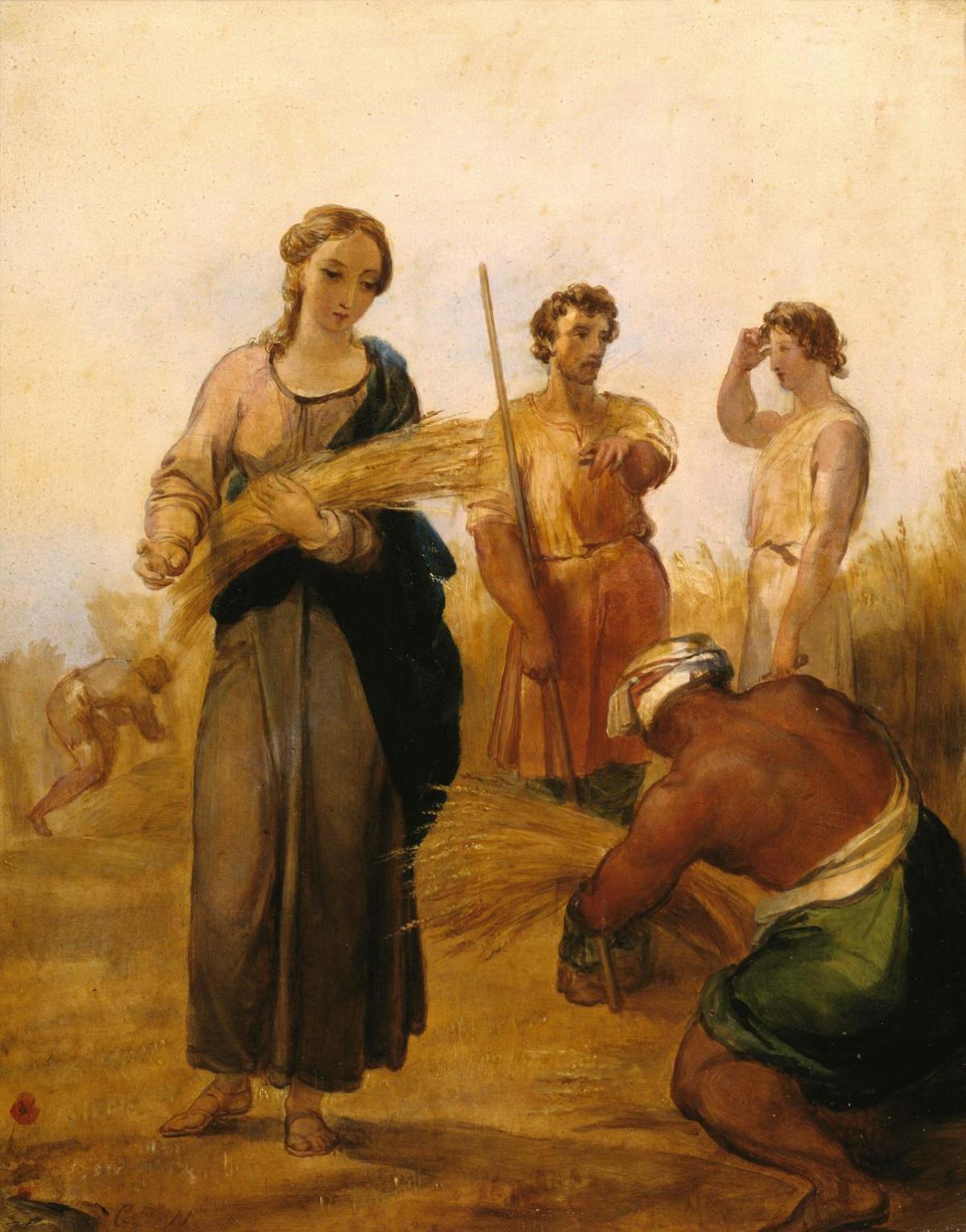
The overarching theological theme in Ruth derives explicitly from her position as a woman and a foreigner within the context of Israelite society. Alicia Besa Panganiban posits in her article “The Theology of Resilience Amidst Vulnerability in the Book of Ruth” that the most disenfranchised members of the Israelite community consisted of poor women, foreigners, and orphans. She writes, “Ruth is the epitome of the most vulnerable member of Israelite society and of our modern society… a poor foreign widow, without any blood relatives in Israel, and worst a Moabite – one who is hated, looked upon with disdain and contempt due to ethnic and religious prejudice.”[6] The writer of Ruth makes a point to include Ruth’s ethnicity as a point of reference on the return journey to Bethlehem, the “house of Bread.” The author’s implication exposed that the blessing of the covenant presented as dichotomous to this excluded Moabite woman. The text states, “So Naomi returned together with Ruth the Moabite, her daughter-in-law, who came back with her from the country of Moab. They came to Bethlehem at the beginning of the barley harvest” (Ruth 1:22). The outsider status excluded Ruth from the blessing of the covenant; however, a new theological understanding promulgates a theology of God desiring to redeem all of humanity through YHWH’s revelatory expression within the covenant community of Israel and climactically through His Christ in the New Covenant.
The fact that YHWH chooses to incorporate the outsider status of Ruth into the redemptive story of the Divine radically altered the intransient patriarchal and religious norms of the original Jewish audience. Subtly at work behind the scenes, YHWH orchestrates the ordinary events, both beneficial and challenging, outside the normative societal structures to fulfill His purposes. Robert L. Hubbard, Jr. writes in his commentary concerning Ruth, “Appeals to Ruth’s theology also enter the discussion. Hence, Hals has argued that behind the book of Ruth lies a firm belief in Yahweh’s absolute but hidden causality. He is everywhere in control but totally hidden behind ordinary human coincidences (cf. 2:3) and conspiracies (cf. 3:1– 4).”[7]
A second critical theological position pursued by the writer of Ruth posits the importance of bridging the divide between those outside the covenant and the Davidic lineage resulting in a Messianic promise. The author accomplishes this reflection by including the eventual climactic birth of Obed and his inclusion in the genealogical presentation ending the book definitively with the name of the Jewish nation’s most significant King, David. The inclusionary involvement of Ruth the Moabitess in this bloodline results in a theological seismic shift from exclusion to inclusion. A foreshadowing of the New Covenantal arrangement introduced through Christ for all humankind. In his book An Introduction to the Old Testament, Walter Brueggemann connects the book of Ruth to the Jewish celebration of the “Festival of Weeks” linked by the fact of the main action occurring on the “threshing floor” (Ruth 3:1-18).[8] He writes concerning the liturgical meaning, “the defining venue for the festival, is understood as a most generative arena in which radical newness is given that opens futures for Israel.”[9] This Israelite understanding of newness and the opening of future blessing points to this opening of new redemptive opportunities for the Gentile nations instituted by the death, burial, and resurrection of Christ.
A final vital theological underpinning within the book of Ruth relates to the Levarite marital commitments and the responsibilities of the kinsman-redeemer (Duet. 25:5-10). Boaz’s voluntary acceptance of Ruth at the threshing floor and commitment to pursue the kinsman-redeemer role in the Levarite tradition illustrates a typological bridge to the kinsman-redeemer of all humankind, Jesus Christ. The salvific bridging of the outsider status caused by sinful rebellion with the holy character of YHWH voluntarily by one not required. John writes of this voluntary giving of Christ in his Gospel, ‘No one takes it from me, but I lay it down of my own accord. I have power to lay it down, and I have power to take it up again. I have received this command from my Father” (John 10:18). Comparatively, Boaz covers Ruth willingly though not required by the Levarite law, and implicitly replaces potential shame with the glory of blessing. This typological covering and exchange perpetrated by Boaz point to a Christological cover and unequal exchange transpiring on the Cross. Paul writes to the Corinthians of this beautiful exchange, “For our sake he made him to be sin who knew no sin, so that in him we might become the righteousness of God” (2 Cor. 5:21).
Conclusion
As the modern reader delves into the nuances of the story of Ruth, as artistically written by the transcriber, a beautiful picture of hope emerges for the outsider and vulnerable of the modern world. The Ruthian text provides a template for engaging the marginalized and helpless in the redemptive story of the Christological thread in the Old Testament, culminating in the person of Jesus. Returning to the genealogical record in Matthew, Daniel I. Block writes, “For as the genealogy of Matthew 1 indicates, one greater than David comes from the loins of Boaz. In the dark days of the judges the foundation is laid for the line that would produce the Savior, the Messiah, the Redeemer of a lost and destitute humanity.”[10] This inclusionary and redemptive history of salvation that extends God’s plan revealed in the story of Ruth and the words of Jesus in the Gospel of Mark, “’When Jesus heard this, he said to them, “Those who are well have no need of a physician, but those who are sick; I have come to call not the righteous but sinners” (Mark 2:17).
Bibliography
Block, Daniel I.. Judges, Ruth: An Exegetical and Theological Exposition of Holy Scripture. Nashville: B&H Publishing Group, 1999. Accessed April 12, 2021. ProQuest Ebook Central.
Brueggemann, Walter. An Introduction to the Old Testament: The Canon and Christian Imagination. Louisville, Ky.: Westminster John Knox Press, 2003.
Childs, Brevard S. Introduction to the Old Testament as Scripture. Philadelphia: Fortress Press, 1979.
Hubbard, Rubert L., Jr.. The Book of Ruth. Grand Rapids: William B. Eerdmans Publishing Company, 1989. Accessed April 12, 2021. ProQuest Ebook Central.
Panganiban, Alicia Besa. 2020. “Theology of Resilience Amidst Vulnerability in the Book of Ruth.” Feminist Theology 28 (2): 182–97. doi:10.1177/0966735019886077.
[1] Alicia Besa Panganiban, “Theology of Resilience Amidst Vulnerability in the Book of Ruth,” Feminist Theology 28, no. 2 (2020): 183, doi:10.1177/0966735019886077.
[2] Unless otherwise noted, all Biblical passages referenced are in the New Revised Standard Version.
[3] Brevard S. Childs, Introduction to the Old Testament as Scripture, (Philadelphia: Fortress Press, 1979), 562.
[4] Ibid, 563.
[5] Ibid, 562.
[6] Panganiban, “Theology of Resilience, 183.
[7] Rubert L. Hubbard Jr., The Book of Ruth (Grand Rapids: William B. Eerdmans Publishing Company, 1989), 27, ProQuest Ebook Central.
[8] Walter Brueggemann, An Introduction to the Old Testament: The Canon and Christian Imagination (Louisville, Ky.: Westminster John Knox Press, 2003), 322.
[9] Ibid.
[10] Daniel I. Block, Judges, Ruth: An Exegetical and Theological Exposition of Holy Scripture (Nashville: B&H Publishing Group, 1999), 696, ProQuest Ebook Central.

 Restored