Introduction
The writer of Genesis begins with an iconic statement, “In the beginning when God created the heavens and the earth, the earth was a formless void and darkness covered the face of the deep, while a wind from God swept over the face of the waters” (Gen. 1:1-2 NRSV).[1] The central character in this story of origins is not the creation itself but the engagement and involvement of the Creator in emanating His creation. The Creation Story and a proper creation theology are critical in preparing the modern theologian for dialogue across multiple academic disciplines, including science, philosophy, human psychology, and religious studies. With the increase in scientific consensus concerning the age of the earth and the function of evolutionary processes in nature, a consistent and biblically-based understanding of the first two chapters of Genesis allows the theologian to engage with confidence. Effective engagement from a position of strength occurs when the theologian provides a consistent, cogent argument aligned with the biblical narrative. In contrast, naïve approaches such as strict young-earth Creationism lead the scientific community to dismiss the theological import of Christians’ views. The Cosmic Temple view of Creation reflected in this paper centers itself within the biblical text and purports to fit appropriately with current scientific knowledge.
In presenting the data for analysis, the basic structure of this study includes research into the divergent views counterproposed and the historical development of Creation Theologies, including the Cosmic Temple view of the Creation Story, setting the stage for the remainder of the paper. The following sections discuss the theory in general, its biblical context, and its importance in engaging with modern philosophy, science, and psychology. The research methodology entails a full spectrum of ideological voices from conservative to liberal to provide a balanced perspective and to guard against presuppositional bias. The divergent views engaged provide a proper foundational analysis commensurate considering the theological significance of the Creation Story. This paper posits that the Cosmic Temple view of the Creation story provides a holistically accurate interpretation allowing for constructive engagement with modern scientific understanding.
Divergent Views of the Creation Story
When approaching the study of the Creation Story, the theologian engages with a variety of views, arising within a postmodern pluralistic environment with little regard for foundationalism and truth propositions. This postmodern environment arose out of the skepticism of the Enlightenment with its focus on reason and the backdrop of modern Science’s Darwinian understanding of the Origins of Humankind. These converging factors exacted pressure on Theistic Creationists, placing them in a defensive position causing a redactional approach to long-held confidence in the Genesis 1 account. In his article “Creation and Interpretation. Hermeneutics and the Theology of Creation,” Jonathan Marvin notes a quote from Terence Fretheim “To speak of creation is to state that the cosmos does not simply exist: it was created by God.”[2] John H. Walton, in his seminal work Genesis 1 as Ancient Cosmology, posits “the confidence of the Western world in Genesis 1 as a foundation for cosmology has eroded, even among individuals who embrace a biblical faith.”[3] To either remove God or reduce God’s involvement in the Creation Story as a foundational element in response to postmodern thought invalidates the efficacy of the text.
In evaluating the Genesis account, Biblical scholars presented diverse theoretical Creation theologies utilizing concentrated morphology and anthropological analysis of Ancient Near Eastern cultures to counter this erosion of faith and redaction of a Creator. One approach detailed by Walton “attempt[s] to transform Genesis 1 into a veiled cosmology, accessible only to the trained modern eye that is able to detect an uncanny correspondence with contemporary scientific knowledge.”[4] This concordist approach attempts to read cosmic geography from the modernist context onto the ancient text.
A second view validates the Creation story as merely theological significance, thereby reducing the ancient text to esoteric themes without literal meaning.[5] In their work Creation, Jeff Astley, Ann Loades, and David Brown exemplify this esoteric, theological view, positing that “Creation is one long preparation, and therefore the being and existence of the creature one long readiness, for what God will intend and do with it in the history of the covenant.”[6] The nebulousness of their assertion connecting creation to process and covenant instead of rooted in creedal confession and historicity is redactional and dilutes the Biblical author’s intention.
A final view reduces the story even further to another analogous mythological rendition of an Ancient Near Eastern people’s attempt to explain their origin story, thus leaving the modern reader of Genesis 1 without a proper anchor of authenticity to validate its origin claims. James Cutsinger, in his article, “On Earth as It Is in Heaven,” argues for this analogous, pluralistic perspective combing metaphysical emanation, theistic creation, and scientific evolution “each intended to account for the world as an organic whole and as possessing determinate form, since it is the cosmos, and not simply the bare facts of existence, that requires explanation.”[7] As Marvin asserts, “The consequences of our understanding of the origin and character of the world are far-reaching. If we fail to articulate and rely on a particular view of creation, we may in effect prioritise a rival conception, an alternative cosmology and ontology which grow from different roots.”[8]
Historical Development of Creation Theology
From the beginning of the Jewish and Christian faiths, theologians proposed various understandings of the Origin Story in Genesis chapter one. Central to these faith reflections of Creation is God’s direct involvement. Veli-Matti Karkkainen, in his book Creation and Humanity: A Constructive Christian Theology for the Pluralistic World, Volume 3, writes, “All three traditions believe in God, loving and Almighty, who has brought about the cosmos and sustains and guides its life from the beginning to the end. The ultimate meaning of the confession of God as Creator is that the whole universe is ontologically dependent on God.”[9] The view of early church theologians grappled with the interaction of the Genesis account and its intersection with their understanding of science. Adam Rassmussen writes concerning this didactic intersection in his book, Genesis and Cosmos: Basil and Origen on Genesis 1 and Cosmology, “In the hexaemeral sermons Basil encountered three specific cosmological problems that Origen also encountered, namely, the nature of matter (Gen 1:2), the water above the sky (Gen 1:6– 7), and astrology (Gen 1:14).”[10] These early church fathers understood science and its relationship as one of servitude, “Origen’s metaphor of secular knowledge as Christianity’s servant is a lens through which we may interpret the various ways in which he and Basil used that knowledge when interpreting Genesis 1.”[11]
A critical, foundational concept in Creation Theology involves understanding the role of God concerning origins. Janet M. Soskice writes concerning a central tenet of creatio ex nihilo, “It affirms that God, from no compulsion or necessity, created the world out of nothing – really nothing – no pre-existent matter, space or time.”[12] Soskice reflects on the impact of this understanding on the theology of Thomas Aquinas “that God could have created, ex nihilo, an everlasting world – that is, a world without beginning or end – although Aquinas believed, on the basis of Scripture, that the world in fact had a beginning.” What is clear is that the early Christian church developed a diversity of thought incorporating various metaphysical interpretations. She goes on to posit that the fact that Aquinas could consider the doctrine to be logically compatible with two different accounts of world origins demonstrates not a cosmological or scientific hypothesis but a metaphysical position and its subject matter, so to speak, is God, although in the hands of exponents such as Thomas Aquinas creatio ex nihilo also has much to tell us about creatures in relation to God.[13] According to Ashford and Bartholomew, “Among the church fathers there was some disagreement about this, so that Justin Martyr, for example, believed that God created from formless matter.”[14] The Cappadocian fathers elaborated on the fact that the “arche [in Genesis 1:1] could include a temporal sense, the ‘beginning’ that immediately precedes actualized time, but for Basil it additionally identifies the ‘skillful Logos’ (τεχνικὀς λόγος) who originally superintended the orderly arrangement of the cosmos, such that it became ‘an academy (διδασκαλεΐον) for rational beings and a school (παιδεντήριον) for acquiring knowledge of God.”[15]
Maren R. Neihoff describes early first-century Judaic thought concerning Origins, “In the first century CE a philosophical formulation of religious dogma, based on the creation of the world, emerged in Judaism. This dogma, which I have termed “monotheistic creation theology,” is particularly concerned with the notion of the Creator’s existence as the only true deity.”[16] The evolution of Judaic thought among Jewish intellectuals after extensive contact with Hellenistic philosophy began to perceive “their religion in more theoretical terms than those who had previously written about the creation.”[17] Lance Jenott and Sarit Katten Gribetz elaborate an artful rendition of the early views of Creation in the context of liturgical expression, “In synagogues and churches throughout the region, the weekly liturgy reenacted the creation story, inserted worshippers into the history of salvation, and reminded them of the fragility of human existence in contrast to the permanence of God’s work.”[18] The praxis of Creation for these early faithful followers of Jesus rooted itself not in theological hierarchy but in the groundedness of faith lived out within the continual creative work of God. Ashford and Bartholomew point out this creedal praxis, “Both the Nicene and the Apostles’ Creeds refer to creation as the first divine action, and both refer to “heaven and earth,” a merism for everything.”[19] Additionally, these early church creeds established a Creational Christology, “The Nicene Creed also includes references to creation in its reference to Christ as the one “by whom all things were made” and to the Holy Spirit as “the Lord and giver of life.”[20]
The Cosmic Temple View of the Creation Story
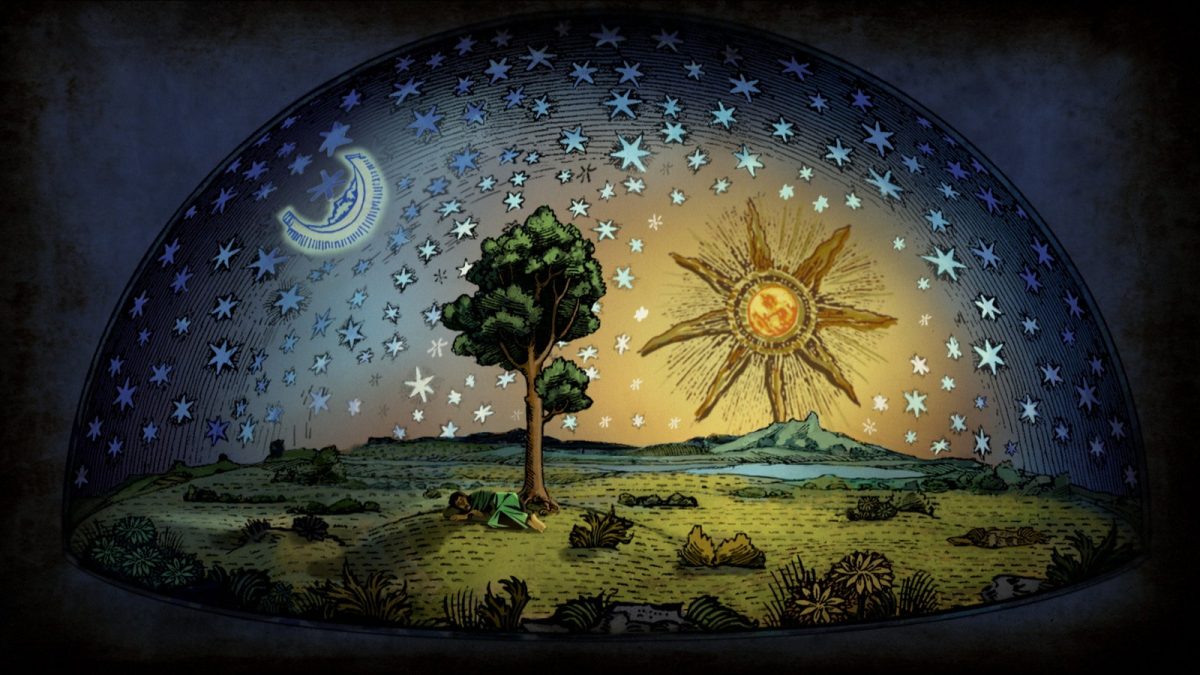
A more recent and intriguing development in cosmological and theological interpretation of the Genesis account of creation falls in the category of a functional assessment of the creation with an overarching Cosmic Temple motif integrating from an understanding of the ancient Israelite cosmography. Walton establishes an ontological basis as the prerequisite for understanding a cultural view of cosmology; he writes, “Understanding ancient peoples’ cosmic ontology must precede discussion of their understanding of cosmic origins because ontology determines what aspect of origins will be of interest and ultimate significance.”[21] The western conceptual ontology concerns itself with “material origins,” Walton posits “In the post-Enlightenment Western world, the framework of cosmic ontology has become strictly material— that is, the cosmos is perceived to exist because it has material properties that the senses can detect.”[22] In contrast, the ancient world viewed cosmology from a different perspective than the western mind. Walton suggests that, “cosmic ontology in the ancient world was a functional ontology —that is, everything exists by virtue of its having been assigned a function and given a role in the ordered cosmos.”[23] This functional understanding of cosmography undergirds the Cosmic Temple view of the Creation Story. Walton, in his book, Ancient Near Eastern Thought and the Old Testament: Introducing the Conceptual World of the Hebrew Bible, writes, “A function-oriented ontology/cosmology bypasses the questions that modern scholars often ask of the ancient world: Did they have a concept of “creation out of nothing?” Did they believe in the eternal existence of matter? These questions have significance only in a material ontology.”[24]
A reorientation of the Creation Story from a material origins account to a more reflective functional ontology provides the basis for categorizing functions created in Genesis to sustain life. When the constraints of reading into the text material creation, the reader begins to unravel the mystery of origins based upon the perspective of the ancient Israelite audience. They viewed the world and its relationship to God as integrated without a distinction between natural and supernatural; these were not concepts familiar because all of the creation exhibited the work of the Divine. The use of the Hebrew word bara in the first verse of Genesis 1 is critical to understanding the work of Creation. Walton explains, “the nuanced meaning of bārāʾ that best suits the data is that it means ‘to bring something into (functional) existence.’ It suggests the establishment of order often accomplished by making distinctions as roles, status, and identity are distinguished.”[25]
On the first yom of Creation, the writer informs us that God established light and darkness or functional initiated time into the cosmos, “Then God said, “Let there be light”; and there was light. And God saw that the light was good; and God separated the light from the darkness” (Gen. 1:3-4) when view from a functional ontology, the importance of the element of time to the remaining functions becomes evident. The second yom God separated the “cosmic waters,” pushing them back to the boundaries of the cosmos to allow for the establishment of life on Earth. Walton describes the terminology and understanding of the ancients concerning “cosmic waters,”
Tĕhôm is neither an enemy to be battled nor an adversary to be defeated. It is simply a term for the cosmic waters, applying either to the precreation context or to the waters at the boundaries of the ordered cosmos. That is, tĕhôm is one of the elements of cosmic geography that parallels what is found in the cognitive environment throughout the ancient Near East. In the precreation period, the tĕhôm covered everything. In the process of creation, it was pushed out to the edges of the cosmos, where it was restrained by the power of God.[26]
Therefore during the second yom, the separation of the waters functionally created a restrained environment pushing back the chaotic elements of the cosmos, providing stability for the continued establishment of life-sustaining functions. During the third yom, this life-sustaining functionality continues with the creation of land and water necessary for food cultivation, “’And God said, “Let the waters under the sky be gathered together into one place, and let the dry land appear.” And it was so. God called the dry land Earth, and the waters that were gathered together he called Seas. And God saw that it was good” (Gen. 1:9-10).
With the establishment of the needed elements for agricultural development, during the fourth Yom God created the function of food production, “Then God said, “Let the earth put forth vegetation: plants yielding seed, and fruit trees of every kind on earth that bear fruit with the seed in it.” And it was so” (Gen. 1:11). The functional creation continues during the fifth yom with the Creator establishing the celestial lights providing seasonal and tidal patterns rooted in the sun and moon, “And God said, “Let there be lights in the dome of the sky to separate the day from the night; and let them be for signs and for seasons and for days and years” (Gen. 1:14). The progression of the creative work of Yahweh continues during the fifth yom period, placing in the air and within the seas living creatures now that the functions of life-sustainment exist. The writer of Genesis states, “’And God said, “Let the waters bring forth swarms of living creatures, and let birds fly above the earth across the dome of the sky.” So God created the great sea monsters and every living creature that moves, of every kind, with which the waters swarm, and every winged bird of every kind. And God saw that it was good” (Gen. 1:20-21). During the sixth yom period, the Creator placed upon the land animals within the now life-sustaining cosmos, “And God said, “Let the earth bring forth living creatures of every kind: cattle and creeping things and wild animals of the earth of every kind.” And it was so” (Gen. 1:24). Reaching the apex of His creative work, God creates humankind to occupy and care for this newly created order, “So God created humankind in his image, in the image of God he created them; male and female he created them” (Gen. 1:27). The Genesis account than can be understood functionally per the standard view of the Ancient Near Eastern peoples, “cosmic creation in the ancient world was not viewed primarily as a process by which matter was brought into being but as a process by which functions, roles, order, jurisdiction, organization, and stability were established.”[27]
A final understanding of the “Cosmic Temple” view of Creation centers on God and the centrality of His role in the narrative. Ancient Near Eastern tribes understood the universe in relationship with the gods and believed the cosmos order existed by the gods and for the gods. Walton writes, “creation of the cosmic temple with all of its functions and with God dwelling in its midst. This is what makes day seven so significant, because without God taking up his dwelling in its midst, the (cosmic) temple does not exist.”[28] The Sabbath element in Genesis helps the reader to recognize the “temple-cosmos equation in Genesis,” the contextual significance of the functions (days 1-3) and the functionaries (days 4-6) supply the necessary elements for the “cosmic temple” and the worship of the Creator.[29] The cosmic temple concept is evident throughout Ancient Near Eastern texts, “In Ugaritic mythology the house Baal seeks for himself is a cosmic temple. [42] In Sumerian literature Gudea’s account of building the Eninnu (the temple to Ningirsu), of the completion and confirmation of the architectural plan, is described in cosmological terms.”[30] The idea that creation creates a place intended for the worship of Yahweh provides a comprehensive view of the Genesis account, leading the reader to an accurate understanding of Yahweh as the Creator and Sustainer worthy of humankind’s worship. Paul furthers this concept by clearly placing the role of cosmic sustainer in the person of Jesus Christ. He writes to the Colossians, “’He himself is before all things, and in him all things hold together” (Col. 1:17). Viewing the universe as a “cosmic temple” held together in Christ allows the modern Jesus-follower flexibility in engaging the modern sciences.
The text in Genesis is not concerned with “material origins” and resists the confines of scientific restriction or literal timeframes. Why God created the cosmos is a more appropriate question than the specifics of how He created it. He created the world and its inhabitants to please Him and express His glory within the context of terrestrial existence. Whether He did the act of creation in six literal days or through an iterative process of evolution and time is not expressed in the details of the text. All of life and creation exist because of their Creator and creation functions to honor Divinity. In the Pharisee’s attempts to repressed creative worship, Jesus responded as recorded in Luke’s gospel, “Some of the Pharisees in the crowd said to him, “Teacher, order your disciples to stop.” He answered, “I tell you, if these were silent, the stones would shout out” (Luke 19:39-40).
Conclusion
The “Cosmic Temple” view of the Creation story provides the most biblically accurate rendition and allows the theologian to engage constructively with scientific discovery. Unloosing the restrictive chains of “material origins” and focusing on the overarching “cosmic temple” and humanity’s role in the worship of the Creator God as well as the functional nature of the Creation narrative allows for an acceptance of modern scientific discoveries as to the material methodologies of the created order. The theistic Creationist can affirm the source of Creation as Divine while leaving the specific details of evolutionary development in the realm of science.
Undoubtedly more research and dialogue is needed with the theological community regarding the Doctrine of Creatine and how to engage the postmodern, pluralistic mindset. The importance of distilling truth to its essence removes presuppositions and backward reading of modern concepts, especially regarding such a narrative as Genesis 1 and the view of cosmic origins. Increased engagement from a solid truth proposition allows for forward progress and revelation to occur. Alan H. Batten sums up the human responsibility concerning the doctrinal understandings of Creation, “If we are persuaded by evidence for design in the physical universe, it necessarily follows that we are a part of that design. This places a responsibility on us. How great that responsibility is depends on our estimate of the possibility and frequency of life in the universe.”[31] The responsibility of the modern theologian is to engage in meaningful discussion respectively to carry forward the doctrines of Creation and provide palatable meaning for the postmodern mind.
Bibliography
Ashford, Bruce Riley, and Bartholomew, Craig G.. The Doctrine of Creation: A Constructive Kuyperian Approach. Westmont, IL: InterVarsity Press, 2020. Accessed November 29, 2021. ProQuest Ebook Central.
Astley, Jeff, Loades, Ann, and Brown, David, eds. Creation. Edinburgh, UK: Continuum International Publishing, 2003. Accessed November 23, 2021. ProQuest Ebook Central.
Blowers, Paul M. “Beauty, Tragedy and New Creation: Theology and Contemplation in Cappadocian Cosmology.” International Journal of Systematic Theology 18, no. 1 (January 2016): 7–29. doi:10.1111/ijst.12136.
Burrell, David B., Cogliati, Carlo, Soskice, Janet M., and Stoeger, William R., eds. Creation and the God of Abraham. Cambridge, UK: Cambridge University Press, 2010. Accessed November 23, 2021. ProQuest Ebook Central.
Cutsinger, James S. “On Earth as It Is in Heaven: A Metaphysical Cosmogony.” Dialogue & Alliance 4, no. 4 (Wint 1990): 45–68. https://search.ebscohost.com/login.aspx?direct=true&db=lsdar&AN=ATLA0000838227&site=ehost-live&scope=site.
Jenott, Lance, and Gribetz, Sarit Kattan, eds. Jewish and Christian Cosmogony in Late Antiquity. Tübingen, DE: Mohr Siebeck, 2020. Accessed November 23, 2021. ProQuest Ebook Central.
Karkkainen, Veli-Matti. Creation and Humanity: A Constructive Christian Theology for the Pluralistic World, Volume 3. Grand Rapids, MI: Wm. B. Eerdmans Publishing Co., 2015. Accessed November 23, 2021. ProQuest Ebook Central.
Marvin, Jonathan. “Creation and Interpretation. Hermeneutics and the Theology of Creation.” European Journal of Theology 26, no. 1 (April 2017): 43–54. https://search.ebscohost.com/login.aspx?direct=true&db=asn&AN=122688937&site=ehost-live&scope=site.
Rasmussen, Adam. Genesis and Cosmos: Basil and Origen on Genesis 1 and Cosmology. Boston, MA: BRILL, 2019. Accessed November 23, 2021. ProQuest Ebook Central.
Robson, John. Origin and Evolution of the Universe: Evidence for Design?. Montreal, CA: McGill-Queen’s University Press, 1987. Accessed November 23, 2021. ProQuest Ebook Central.
Walton, John H.. Ancient near Eastern Thought and the Old Testament: Introducing the Conceptual World of the Hebrew Bible. Grand Rapids, MI: Baker Academic, 2006. Accessed November 23, 2021. ProQuest Ebook Central.
Walton, John H.. Genesis 1 as Ancient Cosmology. University Park, PA: Penn State University Press, 2011. Accessed November 23, 2021. ProQuest Ebook Central.
Walton, John H.. The Lost World of Genesis One: Ancient Cosmology and the Origins Debate. Westmont, IL: InterVarsity Press, 2009. Accessed November 23, 2021. ProQuest Ebook Central.
[1] Unless otherwise noted, all Biblical passages referenced are in the New Revised Standard Version.
[2] Jonathan Marvin, “Creation and interpretation. Hermeneutics and the Theology of Creation,” European Journal of Theology 26, no. 1 (April 2017): 45, https://search.ebscohost.com/login.aspx?direct=true&db=asn&AN=122688937&site=ehost-live&scope=site.
[3] John H. Walton, Genesis 1 as Ancient Cosmology (University Park, PA: Penn State University Press, 2011), 2, ProQuest Ebook Central.
[4] Ibid.
[5] Ibid.
[6] Jeff Astley, Ann Loades, and David Brown, eds., Creation (Edinburgh, UK: Continuum International Publishing, 2003), 89, ProQuest Ebook Central.
[7] James S. Cutsinger, “On Earth as It Is in Heaven: A Metaphysical Cosmogony,” Dialogue and Alliance 4, no. 4 (wint 1990): 45, https://search.ebscohost.com/login.aspx?direct=true&db=lsdar&AN=ATLA0000838227&site=ehost-live&scope=site.
[8] Jonathan Marvin, “Creation and Interpretation. Hermeneutics,” 47.
[9] Veli-Matti Karkkainen, Creation and Humanity: A Constructive Christian Theology for the Pluralistic World, Volume 3 (Grand Rapids, MI: Wm. B. Eerdmans Publishing Co., 2015), 84, ProQuest Ebook Central.
[10] Adam Rasmussen, Genesis and Cosmos: Basil and Origen On Genesis 1 and Cosmology (Boston, MA: BRILL, 2019), 2, ProQuest Ebook Central.
[11] Ibid, 186.
[12] David B. Burrell et al., eds., Creation and the God of Abraham (Cambridge, UK: Cambridge University Press, 2010), 24, ProQuest Ebook Central.
[13] Ibid, 25.
[14] Bruce Riley Ashford and Craig G. Bartholomew, eds., The Doctrine of Creation: A Constructive Kuyperian Apporach (Westmont, IL: InterVarsity Press, 2020), 11, ProQuest Ebook Central.
[15] Paul M. Blowers, “Beauty, Tragedy and New Creation Theology and Contemplation in Cappadocian Cosmology,” International Journal of Systematic Theology 18, no. 1 (January 2016): 7-29, doi:10.1111/ijst.12136.
[16] Lance Jenott and Sarit Kattan Gribetz, eds., Jewish and Christian Cosmogony in Late Antiquity (Tübingen, DE: Mohr Siebeck, 2020), 85, ProQuest Ebook Central.
[17] Ibid.
[18] Ibid, 5.
[19] Ashford and Bartholomew, eds., The Doctrine of Creation, 10.
[20] Ibid.
[21] Walton, Genesis 1 as Ancient Cosmology, 23.
[22] Ibid.
[23] Ibid, 24.
[24] John H. Walton, Ancient Near Eastern Thought and the Old Testament: Introducing the Conceptual World of the Hebrew Bible (Grand Rapids, MI: Baker Academic, 2006), 122, ProQuest Ebook Central.
[25] John H. Walton, Genesis 1 as Ancient Cosmology, 133.
[26] Ibid, 145.
[27] Ibid, 34.
[28] John H. Walton, The Lost World of Genesis One: Ancient Cosmology and the Origins Debate (Westmont, IL: InterVarsity Press, 2009), 85, ProQuest Ebook Central.
[29] John H. Walton, Ancient Near Eastern Thought, 131.
[30] Ibid, 130.
[31] John Robson, Origin and Evolution of the Universe: Evidence for Design? (Carlisle, UK: Langham Creative Projects, 2019), xi, ProQuest Ebook Central.

 Restored