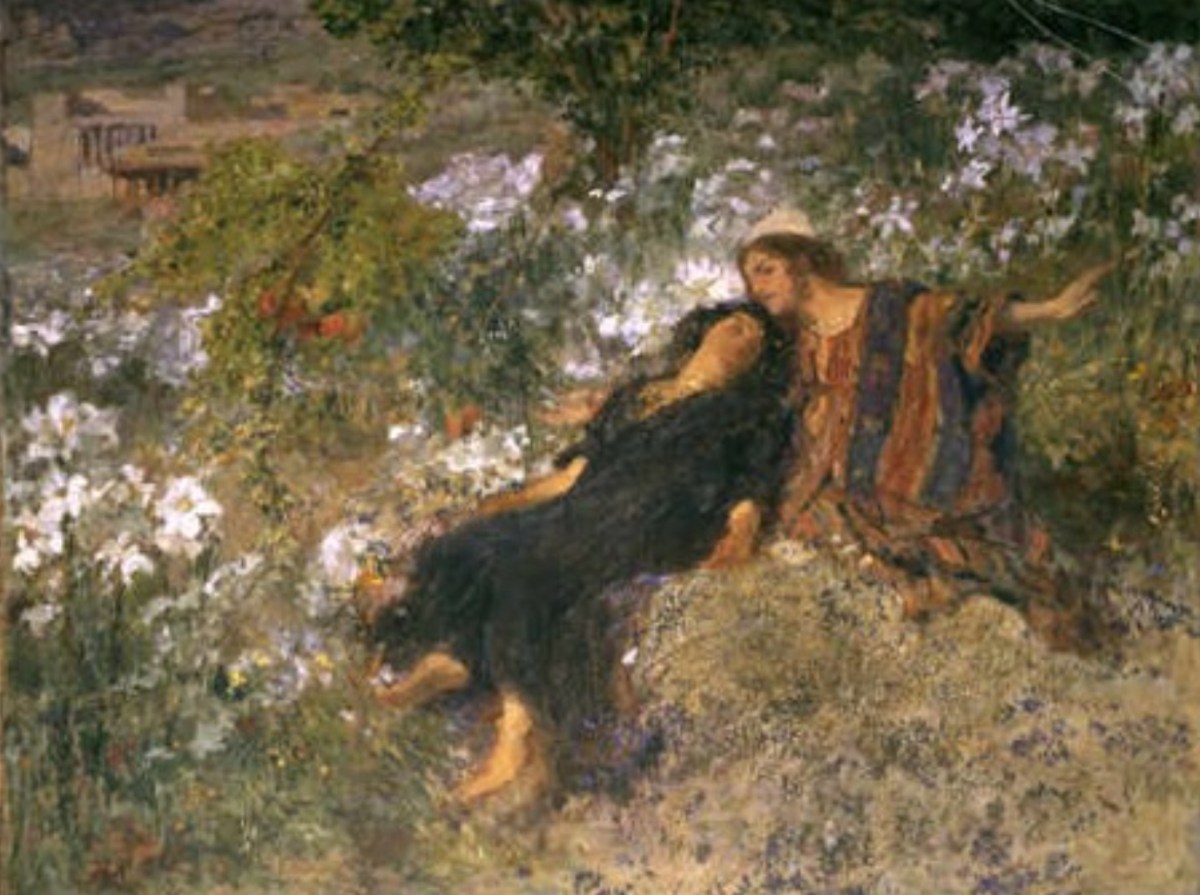
The poetic beauty of the Song of Songs invites the reader into a world of two lovers experiencing the divine gift of human sexuality and intimacy. The author weaves an artistic tapestry that propels the literary imagery to exquisite heights evoking emotional resonance with the characters depicted. In his commentary on Song of Songs, Tremper Longman writes concerning the embedded imagery, “Indeed, the Song presents us with perhaps the largest concentration of imagery anywhere in the Bible, and its images are also among the most suggestive and, at times, enigmatic.”[1] From the opening lines of the Song, the author sets the tone for the expressive artistry to follow, “‘The Song of Songs, which is Solomon’s. Let him kiss me with the kisses of his mouth! For your love is better than wine,” (Song. 1:1-2, NRSV).[2] The Songs imagery evokes an empathic response in the reader intended to immerse them in the sense of the character’s love for each other. Rooted in poetic imagery, a literal understanding emerges of the interplay of male and female love, the author establishes a standard of purity and attainment for those in marital relationships. The wording in chapter four of the Song invites entrance for the lovers into the pleasures of sexual oneness in marriage defined by an undefiled garden of intimate blessing, “‘Awake, O north wind, and come, O south wind! Blow upon my garden that its fragrance may be wafted abroad. Let my beloved come to his garden, and eat its choicest fruits” (Song. 4:16). The ancient Scriptures depicted from the beginning the divine plan for oneness between man and wife. The writer of Genesis details this perfect purity “Therefore a man leaves his father and his mother and clings to his wife, and they become one flesh. And the man and his wife were both naked, and were not ashamed” (Gen. 2:24).
In understanding the literalness of human love as the foundational hermeneutic of Song of Songs, the interpreter extrapolates for the exploratory text evaluation of marital love and the impact on the individual, the couple, and society. When marital love is rooted in mutual respect and affection, as detailed in the Song of Songs, the continuity of the relationship and the impacts on familial continuity bring stability to the surrounding community. We see this societal interaction at several points within the text where relational outsiders react to or engage with the couple to encourage fidelity and continuance. The outsiders’ engagement in the pursuit of Solomon and the endurance of the marriage is detailed in chapter six of the text, “Where has your beloved gone, O fairest among women? Which way has your beloved turned, that we may seek him with you” (Song. 6:1). The inclusion of outsiders in the Song by the author provides an interesting dynamic within a personal love poem. J. Cheryl Exum, in her commentary, posits, “The women of Jerusalem are the audience within the poem whose presence— because it makes the relationship between the lovers less private, less closed— facilitates the reader’s entry into the poem’s world of erotic intimacy.”[3] The inclusion of outsiders permits the reader to peer into the relational dynamics of the couple in their love journey.
The literal, interpretive approach provides a mirror for society to evaluate its interpretation of erotic love compared to the Yahwistic template for humankind. The Song points to a reversal of the curse of sin on the woman concerning her longing for her husband and opens up new dynamics of “mutual longing” and empowerment. The Shullamith demurs, “I am my beloved’s, and his desire is for me.” (Song. 7:10). Estes writes, “This recovery of mutuality in love is, in a sense, a step back toward paradise.”[4] Going even further, Renita J. Weems posits in her essay commentary, “The Song of Songs advocates balance in female and male relationships, urging mutuality not domination, interdependence not enmity, sexual fulfillment not mere procreation, uninhibited love not bigoted emotions.”[5]
To correctly understand the polygamy of Solomon concerning the ideal depicted in the Song of Songs with regards to Shulammith, the reader must appropriate the story as the Divine ideal and the progression described. From the opening, Song 1-3, the reader feels the anticipation of the lovers as their engagement builds and deepens in preparation for the wedding night. The culmination of the wedding establishes a celebratory watermark event in similitude with the modern wedding celebration. After consummation of the lovers, the story delves into the stages of love that provide both exhilaration and despair. Within the chapter five dream sequence, the author peels back the veil to reveal a semblance of sadness that permeates this ideal martial lyric. The poet writes concerning this emotional disconnect, “I opened to my beloved, but my beloved had turned and was gone. My soul failed me when he spoke. I sought him, but did not find him; I called him, but he gave no answer” (Song. 5:6). Daniel Estes writes, “She realizes that she has not communicated to him what she intended to, or what she really feels for him. Her heart goes out to him with a deep emotional surge, but Solomon has departed, and she cannot find him.[6] It is not clear what elicited this disparate dream for Shulammith, but it speaks to the emotional distance that can occur on the journey of marital lovers. Is Solomon’s polygamy in view in this dream sequence as causality for the fears exposed? While not definitive, the fears of emotional distance in this sequence represent the concerns entwined with infidelity and brokenness in marriage. Where is my lover is the common refrain when feelings of distance creep inside. As the woman pursues her lover, a disturbing attack in the night transpires at the hands of the watchmen. (Song. 5:7) Disparate in the context of the “beauty” imagery of the poem, perhaps the author’s intent derives from a place of recognition, a recognition of the perils of love. Exum writes, “Whatever else it may be, the woman’s treatment at the hands of the watchmen is certainly a forceful reminder of the perils of love, if not the willingness of love to suffer…”[7] Shulammith undeterred moves through her emotional valley, returning to what drew her into the depths of love with Solomon and congenial friendship. Estes writes, “Even in their marriage Solomon and Shulammith return to the touchstone of friendship as they endeavor to overcome the painful consequences of insensitivity.”[8]
In view for the reader is the progression of love depicted by the author of the Song of Songs, a passion born in the magical moments of courtship, consummated in the pure sexual oneness of the marriage bed, broken by emotional distance and sin in life, pursued through pain to a lasting endurance until completion. Love overcomes fear and truly conquers all. As the apostle John depicts beautifully, “There is no fear in love, but perfect love casts out fear; for fear has to do with punishment, and whoever fears has not reached perfection in love” (1 John 4:18). In a final depiction of the persistence of Shulammith and Solomon’s love, the author writes, “Many waters cannot quench love, neither can floods drown it. If one offered for love all the wealth of his house, it would be utterly scorned” (Song. 8:7).
Bibliography
Estes, Daniel J. Handbook On the Wisdom Books and Psalms. Grand Rapids, Mich.: Baker Academic, 2005.
Exum, J. Cheryl. Song of Songs (2005): A Commentary. Old Testament Library. Louisville: Presbyterian Publishing Corporation, 2005. Accessed June 4, 2021. ProQuest Ebook Central.
Longman, Tremper. Song of Songs. New International Commentary on the Old Testament. Grand Rapids: Wm. B. Eerdmans Publishing Co., 2001. Accessed June 4, 2021. ProQuest Ebook Central.
Newsom, Carol A., and Sharon H. Ringe. The Women’s Bible Commentary. London: SPCK, 1992.
[1] Tremper Longman, Song of Songs, New International Commentary on the Old Testament (Grand Rapids: Wm. B. Eerdmans Publishing Co, 2001), 22, ProQuest Ebook Central.
[2] Unless otherwise noted, all Biblical passages referenced are in the New Revised Standard Version.
[3] J. Cheryl Exum, Song of Songs (2005): A Commentary, Old Testament Library (Louisville: Presbyterian Publishing Corporation, 2005), 101, ProQuest Ebook Central.
[4] Daniel J. Estes, Handbook On the Wisdom Books and Psalms (Grand Rapids, Mich.: Baker Academic, 2005), 432.
[5] Carol A. Newsom and Sharon H. Ringe, The Women’s Bible Commentary (London: SPCK, 1992), 160.
[6] Estes, Handbook on the Wisdom, 422.
[7] Exum, Song of Songs, 199.
[8] Estes, Handbook on the Wisdom, 424.

 Restored